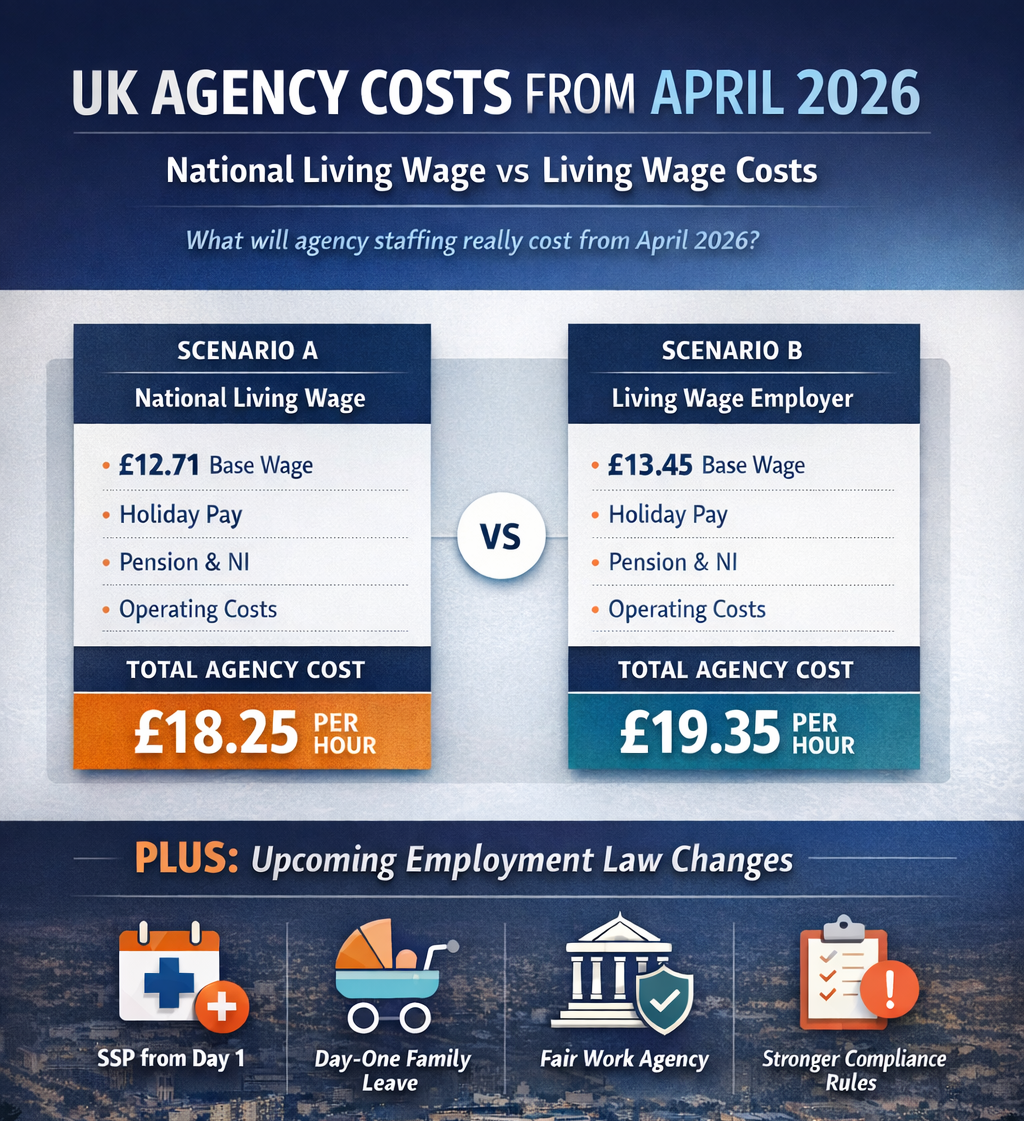
From April 2026, staffing costs in the UK will increase, reflecting not only wage rises but also statutory employment on-costs and new workplace rights. For organisations using agency staff, understanding the true cost of employment has never been more important.
In this blog, we break down agency costs under two scenarios—employers paying the National Minimum Wage (NLW) and those paying the Living Wage (RLW)—and explain how the upcoming Employment Rights Bill reforms will affect staffing costs.
1. Wage Changes from April 2026
National Minimum Wage
The UK government has accepted recommendations from the independent Low Pay Commission to increase the National Minimum Wage for workers aged 21+ to £12.71 per hour from April 2026. (Low Pay Commission – gov.uk)
Real Living Wage
The Living Wage, a voluntary rate calculated based on actual living costs, will be £13.45 per hour (UK rate) for 2025–26, and must be implemented by accredited employers by 1 May 2026. (Living Wage Foundation – UK Rate)
2. What Makes Up an Agency Hourly Rate
An agency’s hourly charge is more than just the worker’s wage. It includes:
Mandatory employment on-costs:
-
Holiday pay (12.07%)
-
Employer pension contributions (3%)
-
Employer National Insurance
Agency operating costs:
-
Recruitment, vetting, and onboarding
-
Payroll and HR administration
-
Compliance, insurance, and workforce management
In this analysis, we assume an agency operating cost of 14% to reflect these ongoing operational expenses.
3. Scenario A – National Minimum Wage Employer
| Component | Hourly cost |
|---|---|
| National Minimum Wage | £12.71 |
| Holiday pay (12.07%) | £1.53 |
| Employer pension (3%) | £0.38 |
| Employer National Insurance | £1.40 |
| Employment cost before agency margin | £16.02 |
| Agency operating cost (14%) | £2.24 |
| Total agency charge (NLW) | £18.25/hour |
This represents the all-in cost of supplying a compliant, agency-managed worker at the statutory minimum wage.
4. Scenario B – Living Wage Employer
| Component | Hourly cost |
|---|---|
| Living Wage (UK rate) | £13.45 |
| Holiday pay (12.07%) | £1.62 |
| Employer pension (3%) | £0.40 |
| Employer National Insurance | £1.50 |
| Employment cost before agency margin | £16.97 |
| Agency operating cost (14%) | £2.38 |
| Total agency charge (RLW) | £19.35/hour |
Difference: ~£1.10/hour, showing the impact of statutory costs scaling with a higher wage.
5. Why the Difference Matters
Although the headline wage difference between NLW and RLW is modest (£0.74/hour), the total cost difference grows once holiday pay, pension, NI, and agency operating costs are added. This is real employment cost, not agency markup.
Many employers choose Living Wage models for the operational benefits:
-
Better retention and reliability
-
Lower absenteeism
-
Higher staff engagement
-
Stronger employer brand
6. Employment Rights Bill: Impact on Agency Costs
The Employment Rights Bill roadmap outlines reforms expected from April 2026 that will influence agency staffing costs. (UK Government Employment Rights Bill Roadmap PDF)
Key changes include:
-
Day-One Statutory Sick Pay – SSP eligibility will be extended to remove earnings threshold and waiting periods.
-
Day-One Family Leave Rights – Paternity and unpaid parental leave from day one of employment.
-
Fair Work Agency Enforcement – Increased compliance scrutiny and potential penalties for non-compliance.
-
Protected Disclosures & Redundancy Rules – Expanded whistleblowing protections and changes to collective redundancy obligations.
These reforms mean additional HR, payroll, and compliance requirements, increasing the cost of managing a flexible workforce — and these costs feed into agency charge rates.
7. Practical Takeaways for Employers
-
Agency rates reflect true employment costs, not inflated profit margins.
-
Living Wage models cost more upfront, but often reduce turnover and absence.
-
Employment Rights Bill reforms will raise administrative and compliance costs for agencies.
-
Transparent pricing helps organisations budget accurately and minimise risk.
Conclusion
From April 2026, understanding the full cost of agency staffing — including wages, statutory on-costs, and legal compliance — is essential for informed workforce planning.
Whether your organisation operates at the National Minimum Wage or chooses the Living Wage, the right agency partner ensures your workforce is reliable, compliant, and sustainable.
Investing in the true cost of employment today protects your organisation from hidden risks tomorrow.
References
-
Low Pay Commission – National Minimum Wage Recommendations 2026
https://www.gov.uk/government/news/lpc-recommendations-take-the-national-living-wage-to-1271 -
Living Wage Foundation – Real Living Wage Rates
https://www.livingwage.org.uk/what-real-living-wage -
Employment Rights Bill – Implementation Roadmap
https://assets.publishing.service.gov.uk/media/6981e6e4e833d031a3158f87/implementing-the-employment-rights-bill-roadmap.pdf -
CIPD – Commentary on Employment Rights Bill Cost Implications
https://www.cipd.org/uk/about/press-releases/cipd-urges-government-clarity-over-employment-rights-bill-needed-costs-rise